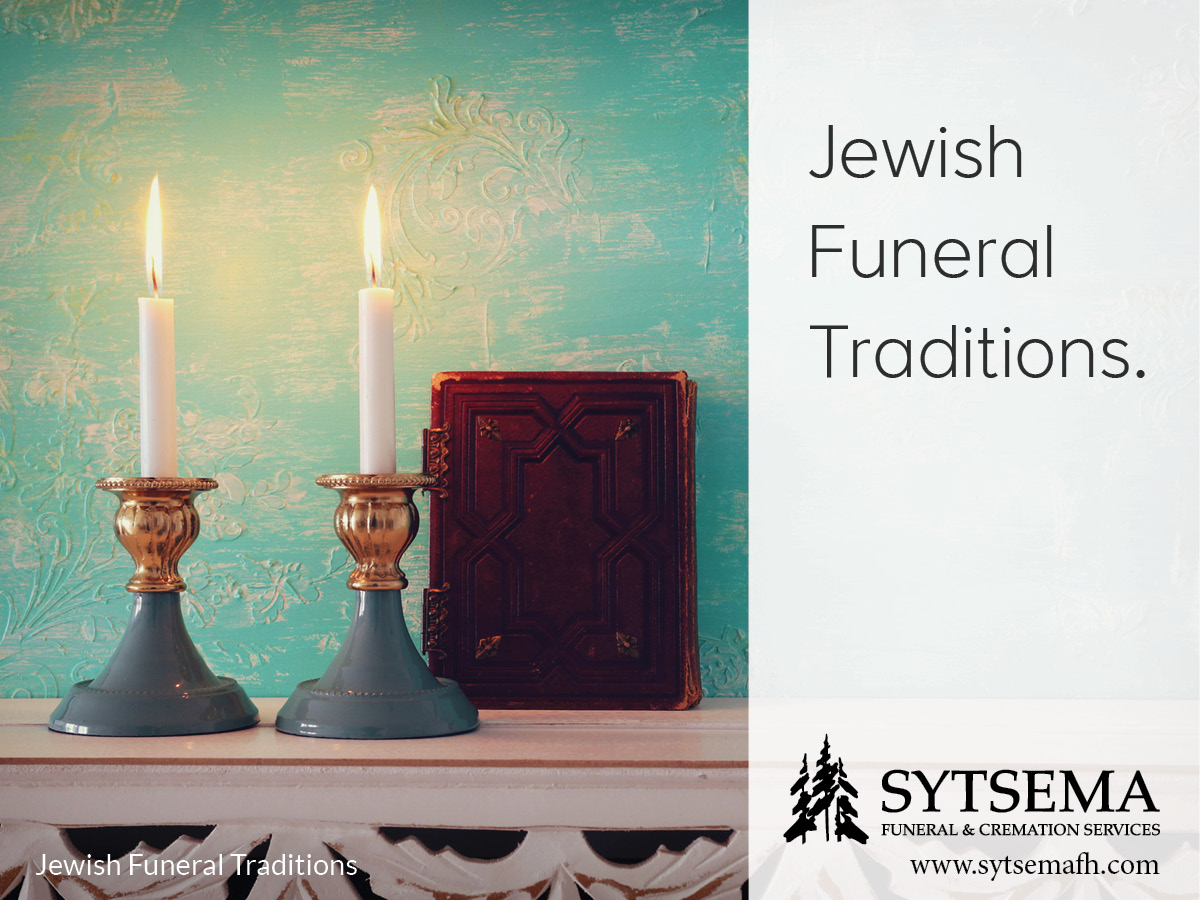
Jewish Funeral Traditions

As we begin to learn more about religious practices outside of our own, it is sometimes surprising to find how much different faiths have in common. Mourners of all faiths understand the power of grief and the comfort of community. So, what happens when a person of the Jewish faith dies, and how can a person outside that faith support a friend or neighbor who is grieving?

In order to support a person of the Jewish faith when they have experienced a loss, one must learn about the Kaddish and sitting Shiva. According to Jewish Law anyone who has lost a parent, sibling, child, or spouse recites Kaddish every day beginning with the funeral and continuing for thirty days after the death. The Mourners Kaddish is a prayer, a profession of faith. The prayer is a listing of God’s holy attributes. Jewish law requires that sanctification of God’s name and requires ten voices … a minyan.  This requirement of a minyan assures that the mourner is not alone. For thirty days the Mourners Kaddish is recited in the presence of at least ten people. According to Anita Diamant in her book Saying Kaddish… “The power of Kaddish comes, in large measure, from the consolations of being in a group that recognizes and embraces the bereaved”.

The Hebrew word for funeral is Levayah, which means “accompanying”. There is no religious requirement for clergy to be present at a Jewish funeral. The responsibility is on the family. The service does not address the ideas of heaven, redemption or reunion, the focus is on the life of the deceased. The service is simple. Here are no flowers or music, the casket is lowered and all in attendance participate in covering the coffin.  Once the casket is lowered the business of caring for the dead is ended. The focus now shifts to mourning and supporting the family in their grief.

Shiva or “sitting Shiva” is a time for the bereaved. Traditionally Shiva lasts for seven days, although in modern times that is sometimes abbreviated to three days. It is a time to “sit” with grief. During Shiva the bereaved do not work or play. No calling into the office, no cooking, no dishes, no television or video games. Shiva is a time to do grief work. It is a time to explore emotions and feelings, to cry and to laugh. It is a time to share memories, tell stories, and receive consolation.

When a Jewish person dies:

  • Expect the service to take place the day after the death.
  • The service will be held either at a funeral home or a synagogue/temple
  • There will never be an open casket
  • The service will be led by a rabbi
  • The rabbi may deliver the eulogy or eulogies may be delivered by friends or family
  • Close friends and family will attend the interment. All who attend the interment will participate in filling the grave.
  • As the closest members of the family leave the gravesite, they pass between two rows of relatives and friends.
  • Do telephone or visit the bereaved
  • Do bring food, to be on the safe side, bring kosher food
  • Do not send flowers
  • Do make a contribution to a favorite charity in honor of the deceased
  • When calling on family members who are sitting Shiva expect to stay for 20 to 30 minutes. The Mourners Kaddish will be recited twice a day, morning and evening. A guest should stand when the mourners stand and read along with the prayer in English
  • The one-year anniversary of the death is marked with a ceremony, yahrzeit. This ceremony is by invitation only and usually involves a service at the synagogue and “unveiling” of the tombstone at the cemetery.

www.sytsemafh.com

How Can We Use Pictures at a Funeral?

Saying good-bye to someone you love is hard. Using pictures at the funeral of the person who died is a wonderful way to help tell a life story. There are a variety of ways to use photos.

Using photos that span the entire life of a person—Mom as a little girl on the farm, as a young bride, a mother, at work, and as a grandmother—just brings it all back. Pictures trigger memories and that is one of the important functions of a funeral. You want to remember the life, not just the illness or accident that ended the life.

A lot of pictures may not be required to tell the story. A few pictures can be enlarged and displayed around the room. If you have a lot of pictures that your family wants to use, they can be displayed in photo frames or albums. Many funeral homes are equipped with electronics that make it possible to show photos on large screens or televisions. These video tributes can be woven into the format of the service or stand on their own for people to view at will. Ask your funeral director for ideas and how they can help you achieve your goals.

Taking the time to come together and go through the family photos can be a healing process on its own. As you are putting together the photos be certain the entire family is well-represented. Everyone will enjoy seeing themselves with the family member who passed.

Remember: funeral directors are helpful people. They want your family to have a good experience. Still, they may not be aware that you have an amateur film producer in the family. Be sure to share the talents that your family has at their disposal as well as your family’s vision for the use of pictures at the funeral. A good picture is worth a thousand words. By all means, use those words and bring out those pictures for the funeral.


www.sytsemafh.com

Choosing Music for a Funeral

If it is given some thought, music can say everything about a loved one.

Too often the power of including music as a part of a funeral service is overlooked. There is a lot to think about when planning a funeral so it is easy to see how music can get lost. There are many ways music can be woven into the service. It can be played as people arrive or depart. Music can accompany the presentation of pictures and it can be played at the graveside. Music can have a little tiny part in the service or have a bigger role.

Almost everyone has “their song” or a band they grew up listening to. A surprising number of folks have musical talent. Maybe they played an instrument or sang in the choir. The music that is played at a funeral can help tell the life story. If as a child, you were forced to endure Frank Sinatra on any road trip you took with your parents, why not include a little Sinatra in their funeral service?

When selecting music for a funeral think more about the person who died and the music they listened to, and less about finding appropriate funeral music. The music you select does not need to be about loss, it just needs to remind folks of the person they loved. The music will mean more to those attending the funeral when the link to the person they loved is clear. If that musical talent trickled down to the next generation, ask a grandchild or child to sing or play at some point during the service.

Not sure about what music mom really liked? Check out her records, CD collection, or playlist. You will likely find what you need. Talk to your funeral director, funeral celebrant, or clergy person to help you determine when and where to use music.


www.sytsemafh.com

Why Don’t We Celebrate Life While the Person is Alive?

Interesting question, isn’t it? The person asking the question had recently attended what he described as a “fabulous funeral.” Turns out the funeral was billed as a celebration of life. Our questioner, Mark, attended because the person who died was the mother of a co-worker he had worked with for more than 30 years.

Mark was so impressed with the woman’s talents, interests, and accomplishments, all of which were highlighted during the service, he said he wished he had known her. The service got him thinking. Perhaps the deceased would have enjoyed seeing how much her neighbors, friends, grandchildren and children thought of her? Mark was thinking it might be better to celebrate a person’s life BEFORE they die.

What about that idea? Don’t we do that? Celebrate a person’s life while they are alive.  It’s called a birthday party. Maybe we hold back a little. Perhaps we don’t gush over the person’s accomplishments as much on the birthday because the birthday boy or girl is too humble to feel comfortable being lauded while present and breathing?

So, is the value of a wonderful life celebration/funeral diminished because the person it was all about isn’t there to enjoy it? Or does the “value” of a funeral run deeper than that?  Isn’t a funeral a validation of the significance of life in general? Might the fact that Mark was so moved by this ordinary women’s life inspire him to make more of his own? Isn’t it a worthwhile lesson for all of us to take a few hours and remember a person who died? Each of us is unique.  Each of us walks a different path. Shouldn’t just about everyone’s life be summed up with a “fabulous funeral”?


www.sytsemafh.com

What is a Celebration of Life?

Do you have to be rich or famous to have a celebration of life?

The celebration of life is the personal or individual aspect of a funeral service. It is about the person who died. It is about their relationships, their loves, their passions, their accomplishments, their beliefs, their talents. It is about what and who they cared about as they lived their own unique life. How did they make a difference?

A person does not have to be rich, or famous, or even publicly successful to have had a life that can be celebrated. Maybe they were simply a dependable friend, or a loving parent, a great teacher, or just fun to be around. Isn’t that enough reason to celebrate?

A celebration of life can be compared to a couple writing all or part of their own vows for a wedding ceremony. It is the part of the service that is about the person. It can be the cookies they baked, the children they raised, the oceans they sailed, the buildings they built. What made them who they are and different from the person who was in this funeral home last week? Why will they be missed?

Believe it or not, every person is unique. We all have a unique fingerprint, ear shape, and “thermal plume”.  Our own little cloud formed of a combination of 44 compounds given off by our bodies as we strut our stuff around town. We are unique. That is what a celebration of life is all about, who we were and how we touched others as we lived our life. Anyone can have a Celebration of Life.

A Life Celebration is not an either-or proposition as in “should we have a religious funeral or a Life Celebration”. It is an and also proposition. You can have both. Especially when a person has a strong belief system that is just part of who they were. Talk to your funeral director. He or she can help you both honor faith and celebrate life.


www.sytsemafh.com