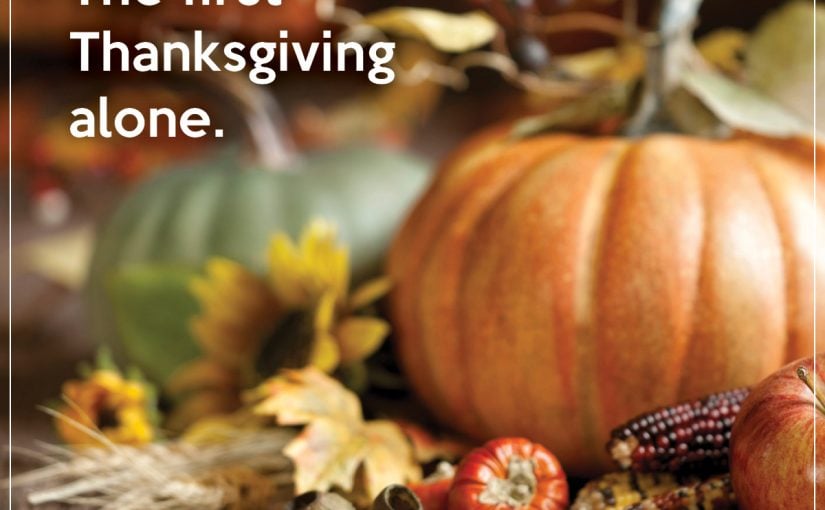
The First Thanksgiving Alone

Thanksgiving looks different to all different kinds of families, but it can also look different year after year. As family members grow up and have their own families, Thanksgiving celebrations may shrink. And as time goes on, the passing of family members can make those smaller Thanksgivings even more emotional. There may come a day when your Thanksgiving will be celebrated alone, which can trigger feelings of grief and loss. How can you navigate a Thanksgiving spent alone? There’s no wrong way, as long as you’re taking care of yourself. 

What to Do When Spending Your First Thanksgiving Alone 

  1. Decide if you’d like to celebrate. 

There’s no rule that says that you have to celebrate Thanksgiving. Sometimes, the most challenging part about the holidays is the expectation. We often remember images of what we think Thanksgiving is supposed to be like: an overflowing table with many family members seated around it, all smiling and having a wonderful time. We may even remember a time in our childhoods when our Thanksgiving dinner tables looked similar to those idyllic images.  


But, more often than not, those images aren’t the reality for most people. You’re not alone if you don’t feel like celebrating when there aren’t others around. It’s okay not to want to put in the work to cook a large meal if you’re only the one eating it. There’s nothing wrong with deciding to skip the usual Thanksgiving traditions. On the other hand, if the traditions give you comfort, you may enjoy simply spending the holiday cooking. Only you can decide if you want to celebrate Thanksgiving when you’re alone. 

  1. Contact others who may also be alone for the holiday. 

If you do decide to celebrate, remember that you may not be the only one celebrating alone. Perhaps a friend has recently been widowed, and their children live far away. Or maybe a recently divorced friend is spending the holiday alone because their children are with their ex-partner. Think about the people you know, and don’t be afraid to reach out and see what they’re up to.  


Suggest a digital alternative if friends or family can’t gather in person. You could ask everyone to grab their favorite Thanksgiving foods and call into an online meeting platform, like Zoom. Even if you only chat for an hour out of the day, you may still enjoy having a little interaction with people you love during what otherwise may be a bit of a lonely day.  

  1. Volunteer. 

Consider celebrating the holiday with people who may also be having a difficult day. Thanksgiving is one of the biggest volunteer days of the year, and the people who volunteer have the honor of helping those less fortunate have their own special holidays. When we volunteer, we’re helping others and helping ourselves. Volunteering our time releases dopamine, making us feel good about the good we’re doing. Seeing that what you’re doing is putting a smile on others’ faces will put a smile on yours.  


Call around to your local food banks, soup kitchens, or places of worship and see who is in need of some help this holiday. When you’re spending a holiday alone, you may find it helpful to take your mind off the situation. Volunteering not only takes your mind off of the day but also puts the focus on someone else, making you feel good about your selfless act. 

  1. Treat yourself with something that you enjoy doing. 

There are other ways to take your mind off the day besides volunteering, however. And especially if you’ve had a difficult time lately, it’s important that you’re taking care of yourself. One way to treat yourself to some essential self-care is by finding a way to put a smile on your own face. If you don’t want to think about the holiday, think about something that will occupy your body and mind in another way. What’s something you don’t often get to do that you really enjoy? Maybe you’ll spend the whole day curled up by the fire with a beloved pet and a good book. Or perhaps you’d rather spend your time in a fishing boat with the sun shining over the water, illuminating your day’s catches.  


Be kind to yourself and let yourself indulge a little. Make a list of things you’d like to do that you don’t do every day, from activities to other treats, like your favorite chocolates. You deserve something that makes you feel good, so enjoy it all without a second thought. 

  1. Consider making preparations for the day with a professional. 

Spending a holiday alone can be challenging, especially if you’re spending it alone because of the passing of a loved one. Sometimes, it’s best to be prepared for any emotions you face during that day. Talking to a mental health professional before the day arrives can help you combat your feelings as they arise. Before Thanksgiving comes around, schedule a meeting with a mental health professional and work with them to create a game plan for the holiday. You may feel better knowing that you’re facing the day with professional advice to help you navigate how you’re feeling.  


Spending your first Thanksgiving alone can bring about a wealth of emotions. Especially if you’re spending it alone because of a loved one’s passing, you may feel more grief than you expect. But remember that there’s no wrong way to observe Thanksgiving alone, even if it means not celebrating at all. No matter what you choose to do, remember to be patient with yourself because ignoring or repressing your emotions may end up causing more harm in the long run. You’re allowed to grieve, even during a holiday. 


www.sytsemafh.com

Memorial Day

Each year when Memorial Day approaches, American citizens get some mixed messages about what the holiday is really about. For many people, Memorial Day is a day off from school or work where they can engage in a BBQ or spend their first day at the beach of the year. But that’s not really what Memorial Day was created for. So, why do we celebrate Memorial Day? And how can we celebrate it with the origin in mind?

Why Do We Celebrate Memorial Day?

Originally known as Decoration Day, the United States has been observing Memorial Day since the years following the Civil War. By the late 1860s, Americans had begun holding tributes for the countless fallen soldiers of the war. The Civil War claimed more American lives than any conflict in U.S. history and led to the creation of the first national cemeteries. Many Americans began visiting the cemeteries during this unofficial holiday to decorate graves with flowers and recite prayers.


Though the holiday was originally meant to honor the fallen soldiers of the Civil War, it has since grown to commemorate the lives of all military personnel lost in any war. Though the first official Decoration Day was on May 30, 1868, it’s believed that the traditions date back earlier, just on different days. However, once Decoration Day began, many Northern states adopted the custom. By 1890, each Northern state had made it an official holiday. However, Southern states honored the dead on separate days.


The day eventually became known as Memorial Day and continued to be honored on May 30. But in 1968, Congress passed the Uniform Monday Holiday Act. The act declared Memorial Day a federal holiday, but it changed the date to the last Monday in May to establish a three-day holiday weekend for federal workers.


While many people today consider Memorial Day to be the unofficial start of summer and a day filled with family get-togethers in the newly-emerged summer sun, it’s important to remember it’s more of a day for commemoration than celebration.

How Can You Honor a Fallen Soldier on Memorial Day

1.   Fly flags that honor soldiers.

Many Americans choose to fly the American flag on Memorial Day as a symbol of patriotism and to honor those who have fallen. However, according to the Department of Veterans Affairs, there are specific guidelines on how to fly it. You should fly the flag at half-staff from sunrise until noon. Then, it should be swiftly raised to the top of the staff until sunset. You can also choose to fly additional meaningful flags for the U.S. military, such as the POW/MIA flag, a reminder of the missing and imprisoned soldiers of the Vietnam War.

2.   Place flowers on a veteran’s grave.

Families often visit cemeteries on Memorial Day to decorate the graves of family members who were veterans. It’s a beautiful way to say thank you to these fallen soldiers. However, if you don’t have a veteran in your own family, you can visit a veterans’ cemetery to decorate other graves. The Department of Veterans Affairs keeps a database of all the veterans’ cemeteries so you can find one near you.

3.   Wear red poppies.

World War I took the lives of an estimated 8.5 million soldiers. Across northern France and Flanders, or northern Belgium, clashes between the Allied and Central Powers destroyed the fields and forests, taking countless lives with them of soldiers and civilians alike. But in the spring of 1915, bright red poppies began appearing in the battle-scarred land. Lieutenant Colonel John McCrae used the poppies as inspiration for his poem, “In Flanders Fields,” which was written from the point of view of the fallen soldiers.


The poppy has since gone on to become a symbol of remembrance. It’s not just an American tradition, though. Several countries don the poppy every November 11 to commemorate the 1918 armistice. However, in the U.S., the poppy is more closely associated with Memorial Day. To wear a red poppy in the U.S. is to honor those who have sacrificed their lives in the name of their country.

4.   Support a charity for fallen soldiers and their families.

A part of honoring fallen soldiers is recognizing how much they left behind in the service of their country. Those who died protecting their country had families who loved them and now may struggle through their loss. Whether you’re able to donate money or time, Memorial Day is a great day to spend time helping these families. However, it’s worth remembering that these people need help year-round, so try to look out for opportunities throughout the year to donate what you can.

5.   Participate in a Memorial Day event.

Many cities and towns throughout the U.S. hold Memorial Day events, such as parades or walks. These events often raise funds for military-based charities, but they’re also an opportunity to shine a light on what Memorial Day is really about. Be on the lookout for events in your area. If you have the ability, get involved with the creation of the event to ensure that it’s befitting of Memorial Day’s history.


6.   Pause for the National Moment of Remembrance.

Each year on Memorial Day, there’s a National Moment of Remembrance. Lasting just one minute at 3 p.m., Americans are asked to silently reflect upon their freedoms and the sacrifices that were made to uphold them. You may also listen to “Taps,” which is often played on local radio stations to commemorate the moment.


Memorial Day is a time to reflect and give thanks to the people who gave their lives to ensure your freedoms today. It’s a day to honor lost lives and support the loved ones those soldiers left behind. They all have sacrificed much. It’s important that we do what we can to give back.


www.sytsemafh.com

What to Give Mom for Mother’s Day

What a word! What a concept! What a job! Mother can be used as a noun, a verb, or an adjective. The female parent of a child or children is a mother. A mother can be a leader of a religious group, or even a term used to designate an elder or senior woman. To mother is to nurture, to invent, to originate.

The word mother has many uses and meanings. Like the word, mothers are not all alike. Some are round and soft, others are straight and firm, some delight and some disappoint. Still, your mother is your mother at seven or seventy. The mother child relationship has staying power like no other. She is yours and you are hers, forever.

Mother’s Day is a time for showing your appreciation for all the effort your mom put into you. Taking care of you when you were sick, cleaning up after you, keeping your clothes clean and a million little things that helped get you to where you are today; So, what is the perfect Mother’s Day gift?

TIME.

For the mother of young children, it might be free time. An hour or an afternoon free from the responsibility of childcare. Time for a soak in the tub or to read a book.

For the mother of a teen it might be time in the form of a shared activity. It could be as simple as working on a puzzle together or watching a movie (no devices in hand) and a little conversation about the movie at the conclusion.

For the mother of an adult child it might be a lunch, FaceTime call or walk with her child. A few minutes or even a couple of hours of just you and your mom.

For the mother of an older child, if you are sixty that probably means mom is in her eighties, how about some time for help? Give advance notice and ask for a list of little jobs or things that are annoying you could fix. Has her computer stopped talking? Does the TV speak the wrong language or have annoying closed captions that just appeared on their own? Has there been an invasion of ants? Are there weeds? What needs time?

For the mother who lives far away take time to write a thank you note to your mom. What do you remember? What do you do now that you learned from her?

TIME, TIME, TIME, … just a little time is what most moms really want for Mother’s Day.


www.sytsemafh.com

Why do we have eggs and chocolate rabbits at Easter?

How did rabbits and colored eggs come to be associated with Easter, the most significant holy day of the year for Christians? To get the answer to that question one needs to go back in time. Imagine yourself on earth before digital, before refractory lenses, before watches. Go way back to when people watched nature to gain some understanding of what was to come.

Envision what it must have been like to watch the days become shorter and darker and not have any idea of what was happening or how long it would last. It’s easy to see how it would be possible to fear the sun was burning out! Then think about how elated people would be when they figured it out. When they observed, and began to record, repeating patterns… the Equinox and the Solstice.

The Winter Solstice is the shortest day of the year and occurs in December. The summer solstice is the longest day of the year and occurs in June. The equinox also occurs twice a year. It occurs when the number of hours of daylight are equal to the number of hours of darkness. As you would expect, the Equinox is a predictor of what’s to come. In the Spring (hooray!) the cold will be coming to an end. Time to plant, fish, and hunt. In the Fall, the Autumn Equinox indicates the time to stock up. Salt the fish, and dry the meat, the cold days are coming.

In Roman times, before Christ, the Pagans (from the Latin, paganus meaning country dweller, villager, or hick) celebrated these natural repeating patterns in a big way. In the Spring the Equinox would be celebrated as a renewal of life. To the Pagans the egg was a symbol of the renewal of life. Eggs were presented to friends as gifts in celebration of Spring. Rabbits, baby chicks, and new fresh green grass were all signs of Spring and new beginnings.

That is what Easter, rabbits, and colored eggs have in common. The Spring Equinox! In 325 AD, at the Council of Nicaea, which was the first major church council, it was decided the celebration of Easter, the resurrection of Jesus from the dead, would be celebrated on the first Sunday following the first full moon after the Spring Equinox.

Since that time, the celebration of the resurrection of Christ has been in the Spring very near the Spring Equinox. As a part of celebrating the resurrection, we go to church, we color and gift eggs, we line baskets with grass, and we devour our chocolate rabbits.


www.sytsemafh.com

How did St. Valentine’s Day get started?

Hearts, flowers, chocolate, the feast day of a Saint, just what is Valentine’s Day? Some tell us it is a holiday created to brighten the cold dark winter month of February. The holiday goes all the way back to the Romans.

The Roman Festival of Lupercalia held in mid-February to celebrate the coming of Spring culminated in a lottery that matched up men and women. It was all about love from the beginning. In the 5th century Pope Gelasius I changed the festival to Saint Valentine’s Day, but the love stuck. Saint Valentine’s Feast Day was associated with courtly love. By the 14th century Valentine’s Day was a day to celebrate romance. Flowers, cards, and chocolate were soon to follow.

Today, on Valentine’s Day we still celebrate love. What could be better? What is more important than those we love? On February 14th we push the pause button on the demands of life and make telling our husbands, wives, children, parents, brothers, sisters, and friends they are important to us and we love them.

It is a little holiday. It does not take a lot to let someone know they are loved.  Remember you will not have these people forever. Take a minute or two to share the love!


www.sytsemafh.com