Leaving Something in the Casket

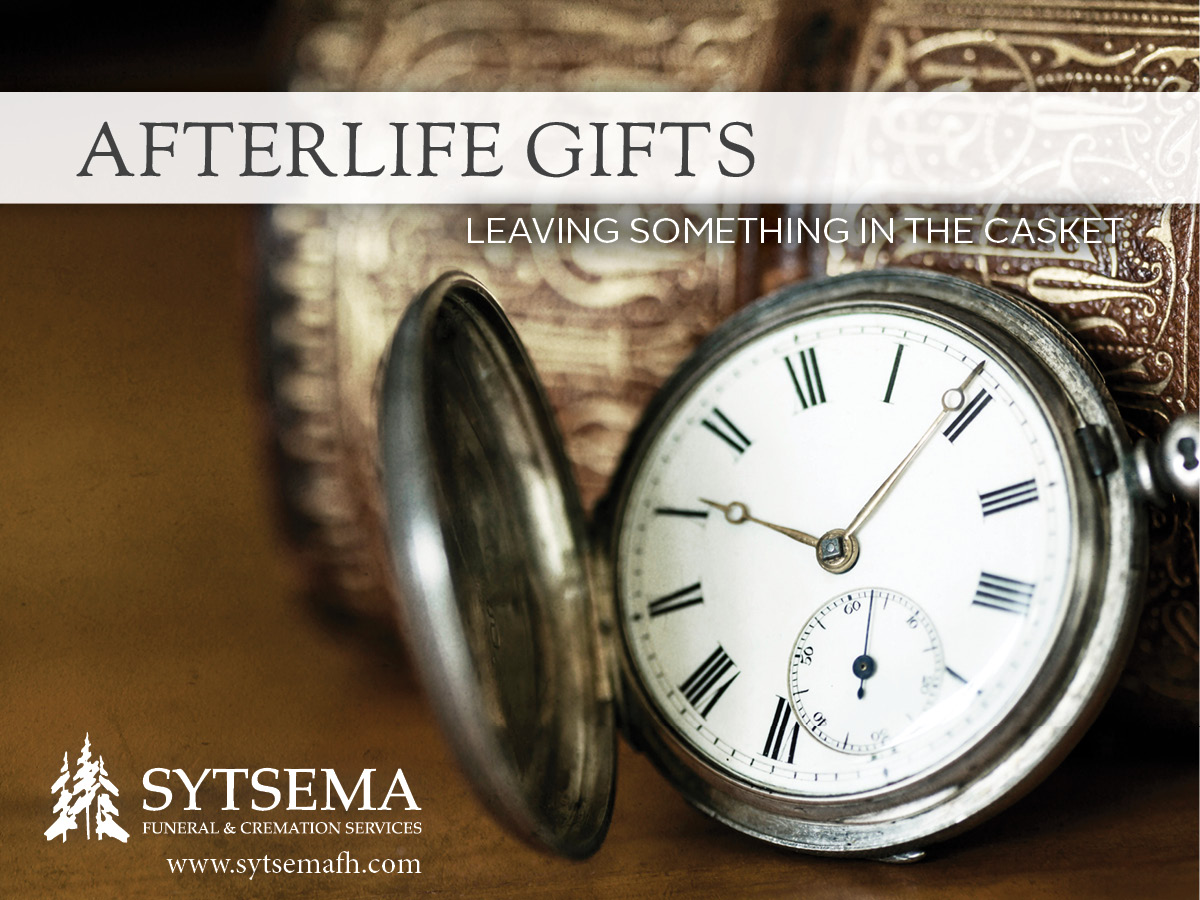
The practice of sending a deceased loved one off with objects from this earthly life is as old as mankind. Ancient Egyptians believed when a person died, they passed into “the afterlife.” Burial goods paralleled objects used in life because it was believed these same objects would be needed in the afterlife. Burial goods included food, drink, tools, make-up, jewelry, pots, gold, and the like.


Even though few people today believe anything placed in the casket will be used by the deceased in the afterlife the practice of placing objects in the casket is alive and well.  Possibly it is because letting go of someone we love is so hard, we find comfort in sending something along with the deceased and keeping something that belonged to the deceased for ourselves.


Most casket manufacturers offer caskets that include a small compartment for mementos family members may want to place with their loved one. Many people like to put a personal note in the compartment. A note can allow mourners to express their emotions or to share a thank you or even to say they are sorry or to express forgiveness for a wrongdoing. Grandchildren often like to put a drawing or love note in the little drawer of the casket. Sometimes it is wedding rings or even a golf ball that are buried with the person who died. What goes into the casket is as varied and individual as the person who has died and the family that loved them.


When we humans lose a wife or husband, mother or father, son or daughter, brother or sister, or dear friend, a hole is created in our life. The space that person held in our life is empty. Still, the love we had for them is not gone. Grieving is difficult and lasts for a good while. Anything that eases the pain, even a little, is good and welcome. Sending something off with the loved one is one way we find comfort. Another is to keep something – a remembrance.


Funeral homes usually offer a wide range of funeral goods for this purpose. There are teddy bears made from a grandfather’s flannel shirt or a gold or silver thumb print that can be worn on a chain or on a bracelet. For those who are cremated there is a whole line of cremation jewelry. These pieces will typically hold a small portion of the ashes.   All one need do is ask their funeral director what is available. The answer will most likely reveal a wide variety of comforting options.


www.sytsemafh.com


Cheap Funeral Homes

The thing about cheap funeral homes is the business model works for them and may not necessarily work for you. You, the person who has just lost someone you love. You, the person who needs the services of a funeral home.


Cheap funeral homes hang their hat on volume. They are playing the numbers. Lots of funerals, little service. The bar is low by design. The professional staff to funeral ratio is low. Fewer skilled people doing more funerals translates to less overhead for the funeral home and determines their profitability.


That can mean families have less time with the funeral director handling their family member’s service. It can mean less consistency. You may not be able to talk to the director you worked with yesterday, today. Fewer people doing more nearly always increases the risk for error. Many people need more help and guidance than they expected when they are tired and numb following the loss of someone dear. The kind of service, how do I write the obituary, how do I notify social security, how do I access my father’s veteran’s benefits, is often not a part of the service model for low-cost funeral providers.


Cheap funeral homes usually have bare bones facilities. The location may be in a light industrial or shopping area. The building may be more like a warehouse and less like a home. The atmosphere may be less comforting than what you and your family are accustomed to when you have worked with your local neighborhood funeral home in the past.


Cheap funeral homes tend to advertise a low-cost bare bones service. Often this service does not include what you expect from experiences you’ve had in the past. You may find things you expected to happen are not going to happen or can only be done at an additional cost. For example, the low advertised price may not include an opportunity for out-of-town family members to say a final good-bye.


As you move closer to what you wanted and expect in a traditional funeral you will move farther away from the low advertised price that first drew you in. By the time you get what you want, if you can get what you want, you may find you are spending more, not less, than you would have spent at your own hometown funeral home.


Before you decide on a funeral provider call your local hometown funeral home. Be up front and clear about your budgetary needs. Funerals leave lasting impressions; they can heal but they can also hurt. You only get one chance to get it right.


www.sytsemafh.com

Nice Looking Funeral Home Doesn’t Mean Expensive

It’s not unusual for your local hometown funeral home to look better than your own home. However, that neatly mowed lawn and manicured landscape doesn’t mean expensive or out of reach. What it does mean is the people who work there pay attention to details, they care about the quality of their work, and they care about you.


A neat and tidy environment calms the mind. According to a 2011 Princeton study, “While our brains are perhaps the most complex structures in the universe, capable of doing amazing things, they’re also easily overwhelmed. A cluttered environment makes it more difficult to focus on a specific task.”  That said, anyone who has ever experienced the death of a close family member or friend knows loss makes it difficult to think straight. The funeral home provides what mourners need, even if they don’t know they need it. You are offered an orderly, calming environment in which to wrestle with the impact of the death of the one you loved.


The funeral home is always company ready. The furniture is pleasant to look at and comfortable to sit in. It is free of pet hair. The carpets are vacuumed, sometimes in neat rows with military precision. All of this is provided so you don’t need to worry if your home is ready to receive guests. The funeral home is your place to receive your friends and family. A burden is lifted from the family when they know they have the support of the staff and a neat and tidy place to receive their friends without having to lift a finger.


How the public spaces look reflect how carefully and respectfully the funeral directors and staff care for your deceased family member. The staff is equally obsessed with the paperwork that needs to be completed, the clergy person has what they need to provide the service, the cars and drivers are escorted safely to the church or grave-site and the deceased is presentable. The great attention to detail the funeral home staff provides translates to comfort and peace of mind for the family members.


So, don’t be put off or intimidated by the lovely décor and neatness of your local funeral home. It’s all a part of the service.


www.sytsemafh.com

Five Tips to Help You Stop Procrastinating About Planning Your Funeral

  1. Set a Deadline


I’ll get this done … before my birthday, before we travel, before school starts, or taxes are due. It doesn’t matter when, just set a target. It only matters that you do have a deadline, especially if you are a habitual procrastinator.


  1. Get In Touch with Your “WHY”


Something made you realize you wanted to get your funeral plan in place. Maybe you had to plan a funeral for someone you cared about? Or, perhaps, you have a family dynamic that makes you see the value of leaving instruction?  Maybe you saw a friend struggle when their spouse died? Whatever it was, write it out, be sure to state your why in positive terms. Instead of “I should,” or, “I need to” tap into that deep motivation. “I want to make my passing is as easy as possible for my wife, daughter, husband.” Post your motivation/why on your fridge.


  1. Call the Funeral Home and Make an Appointment


Funeral homes have a funeral professional who can help you. Make an appointment. Put it on the calendar and sit back and relax.


  1. Tell Someone


Share your good news with someone. Tell them when, where, and why you are going to plan your funeral. Maybe ask them to go with you to the appointment if that feels right to you. At the very least ask them to hold you accountable by checking in the day after your planning session to see how it all went.


  1. Be Honest with Yourself


As the deadline you set or the date of the appointment you made draws near dismiss those second thoughts.


  • You’ll never be in the mood
  • You do have time. You are talking about two hours, that’s all
  • Planning won’t kill you and not planning won’t keep you alive forever


We are all grapes becoming raisins there is no getting around it, and it’s not sad.  Raisins are more resilient than grapes and they are sweeter too!


www.sytsemafh.com

Core Values and Funeral Decisions

From Birth to Funeral … The Best Decisions are Based on a Person’s Individual Values.

There are lots of labels out there. There are categories we are placed in by others or designations we choose on our own. We are male or female, brown, black, or white, boomers or millennials, Baptist, Methodist, Lutheran, republican or democrat. Each of these labels comes with a set of expectations regarding what we value or care about.  Because we are male or female, republican or democrat, a set of values is attached to us.

Being part of a group can be comforting. It is nice to hang out with people who share beliefs and values. There is, however, a downside to labels. They are rarely a perfect fit.  Most of the time individuals share some of the values of their group, but not all of those values. Just because an individual is a woman, it is not a given that she likes to cook and does not like to hunt. That is why it is important for individuals get in touch with their own personal values and base their decisions on those values. The group may provide guidance, but people make their best decisions when those decisions are based on an individual’s personal values.

Decisions regarding the size and make-up of the family an individual will have needs to fit that person’s personal values. Will there be a life partner? Will there be children? Will the children be natural or adopted? Family life works out best when decisions are based on what a person really cares about. Decisions regarding how to celebrate the life of a person we loved who has died will bring the most peace and comfort when they are in sync with personal values. The way in which a life is memorialized provides the most comfort and meaning when it honors the values of the close survivors.

There are a number of websites that offer ideas about how a person can identify their own values. Most suggest limiting the value list to three to five. A person’s core values are deeper than a list of likes and dislikes. Core values are not driven by fear or fad.  They run deep.

A person must ask themselves what they really care about. Things like family, financial security, kindness, faith, environmental stewardship, honesty, responsibility, learning, and balance are all examples of values that resonate with different people. Decisions—who to marry, how many children to have, where to live, what work to pursue, who to vote for, and how to remember a loved one who has died—are all best made based on personal core values.


www.sytsemafh.com